The global ecommerce market is projected to approach $8 trillion by 2028, and in the first quarter of 2026 online sales accounted for 16.8% of US retail sales. Growth is real, but so is competition—Shopify's official guide How To Build an Ecommerce Strategy in 2026 notes that customer acquisition cost (CAC) grew about 40% between 2023 and 2025. For cross-border wholesale buyers, a clear ecommerce strategy is no longer just a brand concern: it is the framework that decides whether sourcing, pricing and channel investment are efficient.
1. Choose your business model first: DTC, marketplace, wholesale or omnichannel
Shopify advises starting with your business model, not your channels. The model decides inventory ownership, pricing logic and customer relationships:
| Model | How it works | Typical examples |
|---|---|---|
| DTC | Sell directly to consumers from an owned online store | Shopify stores |
| Marketplace | Sell to consumers through third-party platforms | Etsy, eBay |
| Wholesale | Sell goods in bulk to other businesses that resell them | B2B bulk supply |
| Omnichannel | Sell across channels with shared inventory and customer data | Website + stores + platforms + social |
For buyers serving small offline stores, wholesale and omnichannel models fit Estroute's service scenario: connecting China, Japan and Korea and Southeast Asian suppliers with store clients that need sample sourcing, negotiation, quality control and logistics support.
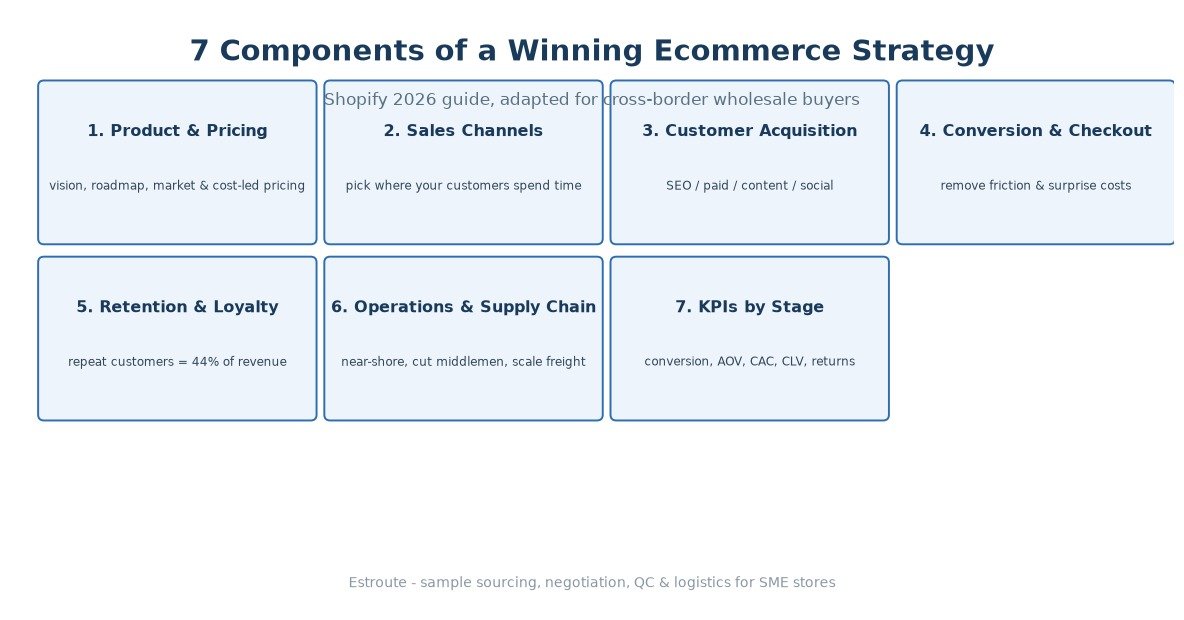
2. The seven components of a winning strategy
2.1 Product and pricing strategy
Define a product roadmap from a clear brand vision, then price with both cost and market in mind. In wholesale, layer products into traffic, profit and image tiers to avoid competing on a single price band.
2.2 Sales channels
Sell where your customers spend time: owned site, marketplaces, offline channels and social commerce. For store clients, display channels must match delivery capability—never promise a lead time you cannot keep.
2.3 Customer acquisition
With CAC up about 40% in two years, acquisition depends on a precise channel mix: SEO, content, paid ads and social media, with cost tracked per channel.
2.4 Conversion and checkout optimization
The top cause of cart abandonment after browsing is unexpected costs (about 40%), followed by slow delivery (20%). Show shipping, taxes and delivery dates up front and use accelerated checkout to lift conversion.
2.5 Customer retention and loyalty
Repeat customers are only 21% of the customer base but generate 44% of revenue and 46% of orders. Post-purchase experience, repurchase incentives and loyalty programs matter—for wholesale clients this means stable replenishment and tiered pricing.
2.6 Operations and supply chain alignment
The guide lists six supply chain actions: produce as close to end consumers as possible, eliminate intermediaries and minimize transfer freight, source your own packaging, scale volume to negotiate better rates, use micro-fulfillment from localized hubs, and retain visibility of the entire chain. Nearly every point maps to a sourcing, QC or logistics decision in cross-border buying.
2.7 KPIs by growth stage
Set KPIs by stage: conversion rate from baseline to segment-level optimization; AOV through bundles and free-shipping thresholds; CAC from volatile testing to stable decline; CLV weighed against CAC to guide investment; fix cart abandonment early; and check health against the national ecommerce return rate of about 19.3%.
3. Marketing strategy: content, email and social that meet demand
Marketing is the amplifier of strategy, not a separate department. The guide splits channels into owned (site, email, SMS), paid (search and social ads) and earned (influencers, user content). Data shows 29% of consumers in Germany, the UK and the US have bought from a brand they discovered on social media, and 32% research products there.
4. Omnichannel: unified inventory and customer data
Omnichannel is not simply opening more storefronts—it means one inventory and one customer view: buy online pick up in store, store stock visible online, and consistent cross-channel loyalty. For buyers with store networks, omnichannel lets wholesale, retail and online displays share one product and inventory logic.
5. Where AI fits in your strategy
The guide recommends making AI part of the strategy explicitly: use tools like Shopify Sidekick to speed up site creation, copywriting and insight generation, and leave team energy for product selection and customer relationships.
6. Practical advice for cross-border wholesale buyers
To apply the framework on the sourcing side, Estroute suggests three priorities: first, set a sourcing strategy by business model—wholesale buyers can diversify across origins to spread cost; second, manage trial sales with stage-based KPIs, validating conversion with small batches before scaling orders; third, move supply chain alignment upstream by using one-stop sample sourcing, negotiation, QC and logistics. For OEM/ODM needs visit our customization service, learn about sample and negotiation workflows on the sourcing service page, or contact us directly.
This article is based on Shopify's official guide How To Build an Ecommerce Strategy in 2026. Core frameworks and data are cited from the guide, with practical notes for Estroute's cross-border wholesale positioning. Original copyright belongs to Shopify.
FAQ
Where should I start when building an ecommerce strategy in 2026?
Start with your business model: DTC, marketplace, wholesale or omnichannel. Wholesale suits sellers supplying other businesses in bulk; after choosing the model, work through product & pricing, channels, acquisition, conversion, retention and supply chain.
How can wholesale buyers put supply chain alignment into practice?
Follow the guide's six actions: produce near demand, cut middlemen, own packaging, scale for better freight rates, fulfill from localized hubs and keep end-to-end visibility. Estroute supports this with one-stop sample sourcing, negotiation, QC and logistics.
How do I know the strategy is working?
Set stage-based KPI baselines: watch conversion, abandonment and CAC tests at launch; optimize AOV and retention in growth; use CLV vs CAC to guide investment at maturity, and check health against the ~19.3% average return rate.
Back to news list