Worldwide ecommerce revenue is expected to reach $3.86 trillion in 2026, and marketing budgets are projected to grow to 7.8% of company revenue by the end of the year. Shopify's official guide, Ecommerce Marketing Guide for Online Stores (2026), opens with a point from Sonsie Skin CEO Kailey Bradt: there is a massive difference between someone who buys your product and someone who invests in your brand—the first may come back if they like what they bought, the second becomes part of your story and tells it for you. For cross-border wholesalers serving small offline retailers, marketing is equally about relationship-building: from the first inquiry to repeat orders, every step builds trust.
1. Start with the three pillars: traffic, conversion, retention
Ecommerce marketing rests on three pillars: attract customers by driving traffic, convert that traffic into sales, and retain customers long-term. In wholesale terms: help store buyers find your supplier pages, use clear pricing, MOQ and sample policies to drive inquiries, and bring them back through order follow-ups and new-category recommendations.
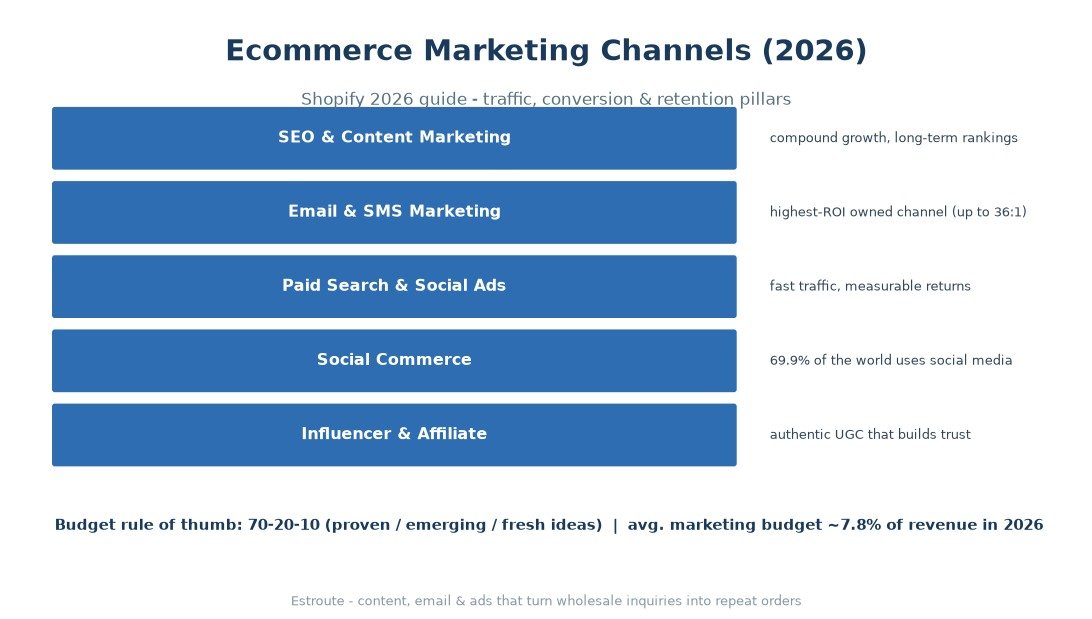
2. Plan before picking channels: stage-based KPIs and the 70-20-10 budget
Shopify recommends completing a marketing plan before choosing channels, with goals tied to your business stage. New businesses establish baselines and test channels; scaling businesses optimize AOV and cost-to-acquisition ratios; mature businesses refine by channel and invest more in retention. For budget, the 70-20-10 approach allocates 70% to proven channels, 20% to emerging ones, and 10% to fresh ideas.
| KPI | New business | Scaling business | Mature business |
|---|---|---|---|
| Conversion rate | Establish a baseline | Test and improve; find the most lucrative channels | Optimize by channel |
| Average order value | Establish a baseline; test pricing | Grow via upsells, bundles, free-shipping thresholds | Grow via personalized offers |
| Customer acquisition cost | Test channels for the best ratio | Scale down cost-to-acquisition ratio | Increase channel diversity |
| Customer lifetime value | Collect data; make informed estimates | Split by persona; build retention strategies | Grow via loyalty programs |
| Cart abandonment rate | Monitor and resolve friction | Run recovery flows (e.g., email) | Reduce extra costs at checkout |
| Return rate | Monitor for early issues | Add product image and description detail | Invest in product improvements; address feedback |
3. How to play the five core channels
SEO and content marketing: the compound channel
Content marketing attracts and engages customers with high-quality content, while SEO and keyword research help it rank higher in search results. Organic traffic takes time but compounds long-term. Wholesale buyers searching for category trends and supplier information are exactly the audience content can win over.
Email and SMS: your highest-ROI owned channel
Litmus's 2025 State of Email report found 35% of businesses see a 36:1 ROI from email. Email and SMS are fully owned channels, free from algorithm control. Welcome emails, promotions, abandoned-cart flows, win-back emails and surveys are common formats. Healthy soda brand Olipop made $30,000 in sales within 15 minutes of one SMS—for wholesalers, new-product and restock alerts to existing buyers work similarly well.
Paid search and social ads: fast traffic, measurable returns
Paid advertising is like a tap: turn it on and leads come; turn it off and they stop. Google search ads put your brand in front of buyers with clear intent, while social ads target by audience criteria. Success comes from research-backed creative, clear goals and continuous iteration on performance data.
Social commerce: selling where your customers already are
69.9% of the world's population uses social media. TikTok, Instagram and YouTube are not just brand showcases but sales channels. B2B buyers are active on social media too—showing factories, samples, QC and logistics lowers the trust barrier in cross-border trade.
Influencer and affiliate marketing: building trust with UGC
Affiliate marketing lets creators recommend products via unique links and earn commissions on sales. This user-generated content feels authentic and trusted. Wholesalers can partner with industry KOLs and buyers who know local markets to reach target retail audiences precisely.
4. Strategies that drive repeat purchases
Repeat purchases are the core of profitability. Shopify recommends three approaches: life-cycle automations (welcome, abandoned-cart and win-back flows); customer segmentation for personalization (73% of marketers believe personalization will improve as technology advances); and loyalty programs plus brand communities to build long-term relationships.
5. How AI is changing ecommerce marketing
The AI-in-marketing market is estimated at $35 billion in 2026, expected to reach $82.2 billion by 2030, a 25% CAGR from 2025 to 2030. Shopify Audiences generates high-intent audience lists from US and Canada purchase behavior for precise ad targeting; Sidekick and Campaign Autopilot can draft emails, generate images and recommend campaign actions. Wholesalers can use AI for multilingual product copy, inquiry triage and ad creative testing to cut trial-and-error costs.
6. How to measure performance
Core metrics include average order value (AOV), customer acquisition cost (CAC), retention rate, customer lifetime value (CLV) and return on ad spend (ROAS). Shopify's commerce operating system attributes online and POS in-person actions to the same customer profile for clear multichannel attribution. For cross-border wholesale, add inquiry cost and store reorder rate to your KPI sheet, and let data decide where the budget flows.
For Estroute, small retailers and buyers can start with three actions: use content and social media to move the sample-finding, price-comparison and factory-audit decisions earlier and lower acquisition costs; use email and follow-ups to put customers into a reorder rhythm; and recalibrate budget against AOV, inquiry cost and reorder rate. Need OEM/ODM customization? Contact our customization service, learn about sampling and negotiation via sourcing services, or reach out to us directly.
This article is based on Shopify's official guide, Ecommerce Marketing Guide for Online Stores (2026), with the core framework and data quoted from the guide and additional implementation notes for Estroute's cross-border wholesale positioning. The original content is copyrighted by Shopify.
FAQ
Where should I start with ecommerce marketing in 2026?
Complete a marketing plan first: set KPI baselines for your business stage (conversion rate, AOV, CAC, CLV, cart abandonment and return rate), then allocate budget across paid, owned and earned channels using the 70-20-10 approach.
Which channels are most effective for ecommerce?
SEO and content marketing compound long-term; email and SMS deliver the highest ROI among owned channels (35% of businesses see 36:1); paid search and social ads bring fast traffic; social commerce reaches 69.9% of the world's social media users; influencer and affiliate marketing builds trust through UGC. The best mix depends on your audience—test with a small budget, then scale.
How should wholesale buyers measure marketing performance?
Track AOV, CAC, retention rate, CLV and ROAS, and add wholesale-specific KPIs like inquiry cost and store reorder rate; use unified attribution to see the full journey from first touch to repeat order.
Back to news list